There is a very particular moment when everything truly begins.
The carrier is placed on the floor. Silence settles in. Inside, a cat observes a world it does not yet know. For you, it is an arrival. For them, it is a rupture.
It is often at this precise moment that the first worries appear. Why won’t they come out? Why are they hiding? Why are they not eating? Is this normal… or is something wrong?
The first days are rarely what we imagine. There is not necessarily immediate purring, nor spontaneous closeness. And that is precisely what can feel unsettling.
And yet, this phase is essential.
It is not meant to create a bond. It is meant to create a sense of safety.
And it is this safety — invisible but fundamental — that determines everything that follows.
The first hours: entering their world, not the other way around
“They stay hidden and won’t come out… should I be worried?”
No. What you are observing is not a problem. It is a deeply natural behaviour.
A cat never approaches a new environment lightly. They analyse, observe, evaluate. Hiding allows them to reduce pressure, step back and regain a sense of control.
It is an adaptation strategy, not a sign of distress.
What may seem worrying to us — that silence, that distance — is in fact a healthy mechanism. The cat is building, in their own way, the foundations of their future balance.
Trying to make them come out, actively reassuring them, intervening too early… often slows down this process.
Trust cannot be forced. It is allowed to emerge.
“Should I stay with them or leave them alone?”
The answer lies in nuance.
Being present without being intrusive is probably the most appropriate attitude. You can simply be in the room, read, speak softly, move calmly… without trying to initiate contact.
The cat observes you. They register your presence, your behaviour, your movements. They are already learning that you are not a threat.
And it is often in these quiet moments that a first step towards you appears.
A glance. A hesitant approach. A pause a few metres away.
These are valuable signals.
They mean: “I am beginning to feel safe enough to exist near you.”
“Should I show them the whole house?”
The temptation is natural. We want them to discover their new environment, to have access to everything.
But for a cat, too much space too quickly can become confusing.
It is often better to start with a simple, clear, reassuring area. A quiet room or a well-defined space where they can find their bearings without feeling overwhelmed.
In this first territory, everything makes sense: the litter tray, water, food, a hiding place, a place to observe, and something to scratch.
This is where they begin to understand. And above all, to relax.
The rest will come naturally.
Food, litter… and the signals that worry you

“They are not eating… is that normal?”
This is one of the most common — and most legitimate — concerns.
Yes, a cat may refuse to eat when they first arrive. Stress directly affects their appetite. As long as they do not feel safe, their body remains in a state of alert.
In this context, insisting, changing food repeatedly or pushing them can make things worse.
What truly helps is consistency.
Keeping the same food they had before, offering it in a calm place, avoiding unnecessary handling… all of this reduces pressure.
Gradually, as tension decreases, appetite returns.
However, beyond forty-eight hours, it is important to remain attentive and seek advice from a professional if needed.
“They are not using the litter tray… is that a bad sign?”
Not necessarily, but it is something to observe carefully.
A cat is naturally clean. If they do not use the litter tray, it is never out of defiance. It is always a response to something.
Sometimes it is simply stress. Sometimes it is a detail: a location that is too exposed, a smell, a texture they dislike.
What is important to understand is that the litter tray is not just an accessory. It is an intimate, sensitive space.
When they feel comfortable there, everything becomes simple again.
Rhythm, night and the habits that begin to form
“They meow at night… why?”
The night amplifies sensations. Silence, darkness, the absence of activity… everything can make the environment feel more intense.
A cat that meows is not necessarily trying to get attention. They are often expressing discomfort, a search for reassurance, sometimes even loneliness.
Responding immediately may feel reassuring… but it can also create a habit.
What helps more is gradually creating reassuring routines: evening playtime, structure, a stable presence.
With time, nights become calmer.
“Can they sleep with me from the beginning?”
This is a personal choice, but one that deserves consideration.
A cat adapts very quickly to what is allowed. What you permit from the start becomes a norm for them.
If you prefer to maintain some distance, it is best to establish it from the beginning.
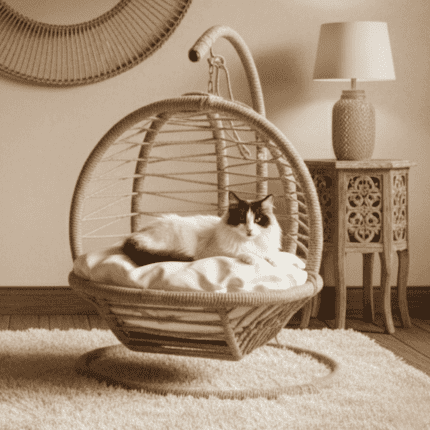
Providing a comfortable sleeping area, ideally elevated, allows them to find a place that suits them naturally.
Building a bond… without rushing it
“When will they come to me?”
There is no universal answer.
Some cats approach very quickly. Others take time. Sometimes a lot of time. What matters is not the speed. It is the quality of that moment.
When a cat comes to you for the first time, it is never insignificant. It is a decision. A choice. And that choice is the result of everything you have done… or rather, everything you have not forced.
“How should I play with them at the beginning?”
Play is an excellent way to build a connection… but it must never be imposed.
At first, some cats do not play. Not because they dislike it, but because they are not ready yet.
When the moment comes, play becomes a language.
It allows the cat to express their hunting instinct, to release energy, to gain confidence.
And gradually, they begin to associate your presence with something positive.

The invisible mistakes… but decisive ones
“What can really make the first days more difficult?”
It is rarely big mistakes. It is small things, done with good intentions. Wanting to reassure too quickly. Multiplying interactions. Inviting people over to “meet” the cat. Handling them before they are ready.
All of this comes from a genuine desire… but does not match what the cat actually needs.
At the beginning, what they need most is simplicity. The less pressure there is, the more they open up.
Specific situations
“With children, what should I do?”
The arrival of a cat is often an important moment for a child. But it is also a moment that requires clear boundaries. A cat is not a toy. They need calm, space and respect. Teaching a child to observe, to wait, to let the cat come… is also teaching a more respectful relationship with a living being.
“What if there is already another animal?”
Introductions should never be rushed. They are built step by step, often through scent before sight. Each animal has its own rhythm, reactions and limits. Forcing an encounter creates unnecessary tension. Allowing time creates real coexistence.
The first days with a cat are not meant to create a relationship. They are meant to create a framework. A framework in which they can gradually relax, understand, explore… and one day, come to you.
And on that day, everything will be different.

















Leave a comment