Neutering a cat is not simply a matter of everyday convenience. It is a decision rooted in prevention, protection and responsibility — one that affects not only the animal’s health, but also the balance within the home and the broader management of feline populations.
Still surrounded by persistent misconceptions, neutering deserves a clear and nuanced explanation: why it matters, when to do it, how the procedure works, what it costs, what the real risks are, and what role each of us can play.
This guide offers a clear, well-informed and accessible perspective to help you better understand this important decision — without guilt, but with reliable and practical insight.
A decision that goes far beyond simple convenience
For a long time, neutering was seen as a matter of practicality. Today, it is understood within a much broader framework, at the intersection of preventive medicine, animal welfare and shared responsibility.
Behind this decision, often taken for practical reasons, lies a more complex balance. It involves the cat’s health, the quality of life within the household, and, more discreetly, the regulation of feline populations on a wider scale.
Neutering is therefore not just a personal choice. It also contributes to preventing unwanted litters, limiting the number of stray animals and improving overall animal welfare.
Why neutering truly makes a difference
An often underestimated medical benefit
The medical value of neutering is sometimes overlooked, even though it is one of its strongest foundations.
In female cats, not being neutered increases the risk of serious conditions, some of which can be life-threatening. Mammary tumours and uterine infections, in particular, remain well-documented realities. These conditions often develop silently and can be complex and costly to treat.
In male cats, the benefits are expressed differently but are no less significant. By reducing hormone-driven behaviours, neutering indirectly lowers the risk of injuries, fights and related infections. It is a less visible, but equally meaningful form of protection.
A calmer daily life — without unrealistic promises
It would be tempting to present neutering as a universal solution to behavioural issues. The reality is more nuanced — and it is precisely this nuance that allows for a more accurate understanding.
Hormone-related behaviours such as spraying, roaming or vocalisation during heat are generally reduced, sometimes significantly. The cat becomes more stable, and daily life more peaceful.
However, it would be misleading to assume that all behavioural difficulties disappear. Stress, anxiety or an unsuitable environment will continue to affect the animal. Neutering addresses part of the issue, not its entirety.
A discreet yet decisive impact on a broader scale
Beyond the home, neutering takes on a wider significance that is often less visible.
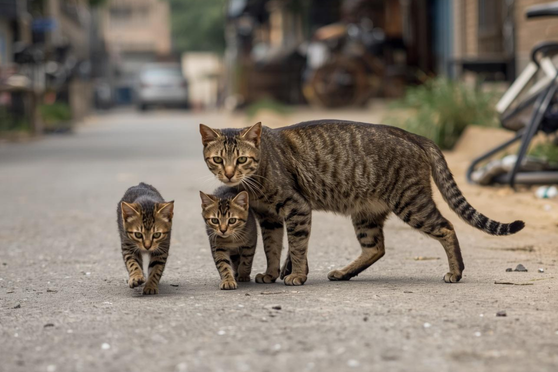
Every unplanned litter contributes to a reality well known to those working with animals: growing numbers of stray cats, overwhelmed shelters and complex welfare situations. Neutering plays a key role in limiting these issues and improving living conditions for many animals.
It is not a spectacular act. Yet it is one of the few individual decisions that can have a lasting collective impact.
The right timing: simpler than it seems
For a long time, it was common to wait for the first heat cycle, or even for a first litter. These ideas are now largely outdated.
Current approaches tend towards earlier neutering. In many cases, it is carried out around four to five months of age, before puberty.
This shift is significant. It helps prevent the onset of hormone-driven behaviours and avoids unwanted reproduction from the outset.
In practice, however, the aim is not to follow a rigid timeline, but to choose the right moment for the individual animal. Health, lifestyle and history all play a role in this decision.
How neutering is performed today
The image of neutering as a heavy or uncertain procedure no longer reflects modern veterinary medicine.
In most cases, the process is straightforward: the cat is admitted in the morning, undergoes surgery during the day and returns home a few hours later.
In male cats, the procedure is quick and minimally invasive. In females, it involves abdominal surgery, requiring more precision and monitoring.
Beyond the surgical act itself, the overall standard of care has evolved considerably. Anaesthesia is better controlled, pain management is more advanced, and the recovery phase — particularly the moment of waking — is closely monitored.
Before the procedure
Before surgery, the cat’s general health is assessed. Depending on age or medical history, additional checks may be recommended. The goal is to adapt the procedure to the individual animal rather than apply a one-size-fits-all approach.
Preparation at home also plays a role. Fasting, transport and ensuring a calm environment all contribute to a safe and smooth procedure.
On the day of surgery
The procedure is performed under general anaesthesia, ensuring that the cat feels no pain. Pain relief is administered to support comfort during recovery.
In most cases, the cat can return home the same day once it is stable and sufficiently awake.
After the procedure
Back at home, rest is essential. The cat should recover in a warm, quiet and secure environment.
Observation focuses on behaviour, appetite, wound healing and overall comfort. Clear instructions from the veterinary team help guide this period and ensure a smooth recovery.
Cost: understanding rather than comparing
The cost of neutering can vary depending on several factors.
Generally, the procedure is less expensive for male cats than for females, as it is technically simpler.
However, a price alone tells only part of the story. What truly matters is what is included: pre-operative checks, anaesthesia, pain management and follow-up care.
Comparisons are only meaningful when based on the full scope of care provided.
Why do prices vary?
Differences can be explained by the animal’s sex, the facilities available, the medical protocols used and the level of care offered.
A lower price is not necessarily a concern, but it should always be understood in context.
Are there ways to reduce the cost?
In many areas, support schemes or local initiatives may help reduce the cost of neutering, particularly for those facing financial constraints.
These can be offered by local organisations, veterinary networks or public programmes. It is often worth exploring what is available locally.
Common misconceptions about neutering
Several ideas about neutering persist, despite being outdated.
“A female cat should have a litter first”
This belief has no medical basis and stems more from tradition than science.
“You should wait for the first heat”
This recommendation is now considered outdated, with earlier intervention often preferred.
“For male cats, it’s mainly for human convenience”
This view is too narrow. Neutering also reduces health risks and dangers associated with roaming.
“Pain relief is not necessary for such a routine procedure”
This is inconsistent with modern veterinary standards. Pain management is an essential part of care.
“Neutering always causes weight gain”
Weight gain is not inevitable. Diet and lifestyle remain the determining factors.
Understanding the risks realistically
Neutering is a surgical procedure and therefore not entirely without risk.
However, serious complications are rare in healthy animals. The most common issues are related to anaesthesia or recovery and are generally well managed.
What truly matters is the quality of care provided before, during and after the procedure.
A shared responsibility
Neutering is part of a broader system involving multiple stakeholders.
Veterinarians ensure medical safety, organisations contribute to awareness and population management, and public initiatives can support access to care.
Owners also play a key role by making informed decisions and helping prevent unwanted litters.
Informing without judging
Many people hesitate due to a lack of clear information or conflicting advice.
Providing accurate, balanced information helps support informed decision-making.
Neutering is not a slogan, but a subject that deserves understanding and perspective.
Conclusion
Neutering a cat is not a trivial decision. It involves health, behaviour and responsibility at the same time.
In most situations, it is a thoughtful and forward-looking choice that offers long-term benefits.
As often, the best decisions are not those imposed — but those truly understood.













Leave a comment