He has already chewed through half the sofa. He barks at the door as soon as you leave for work. She spends all day sleeping, then suddenly becomes hyperactive at 10 p.m. If any of these scenes sound familiar, your pet probably does not lack love or even physical exercise: they lack mental stimulation.
We take our dogs for walks, play with our cats using feather wands and offer them high-quality food... yet we often forget the most important part of their overall well-being: their brain. At Merlin & Cie, this is a subject particularly close to our hearts, so make yourself comfortable: we are going to explain why intelligence games can genuinely transform your pet’s life and how to choose the right one.
Why mental stimulation is just as important as a walk
We tend to believe that a physically tired dog is a fulfilled dog. That is true, but it is not the whole story. Animal behaviourists regularly remind us that around ten minutes of active problem-solving can tire a dog as much as an hour-long walk. Searching for a treat, solving a mechanism or operating a lever engages areas of the brain that physical exercise alone does not stimulate.
This distinction is particularly important for:
- dogs and cats living in towns and cities, who do not always have access to large spaces in which to exercise;
- senior pets or animals recovering from illness or injury, whose physical activity may be limited but whose minds still need stimulation;
- anxious animals or pets that are left alone for part of the day, for whom boredom can quickly turn into stress, destructive behaviour or behavioural problems;
- indoor cats, whose hunting instincts remain fully intact even when there are no mice to chase.
A pet that uses its brain is generally calmer, more confident and often closer to you. Searching for a reward together creates a genuine moment of bonding, rather than simply providing something to pass the time.
How to recognise a bored dog or cat
Before rushing out to buy the first toy you see, there are several unmistakable signs to look out for:
- destroying objects, furniture or shoes;
- excessive barking or meowing, particularly when you leave;
- compulsive licking, pacing or restlessness at night;
- a cat that “hunts” its dry food by knocking it onto the floor or constantly demands attention.
None of this means that your pet is “difficult”. They are simply telling you that they need a challenge suited to their abilities.
The main types of intelligence games
Not all intelligence games are the same, and that is a good thing: every animal has their own preferences.
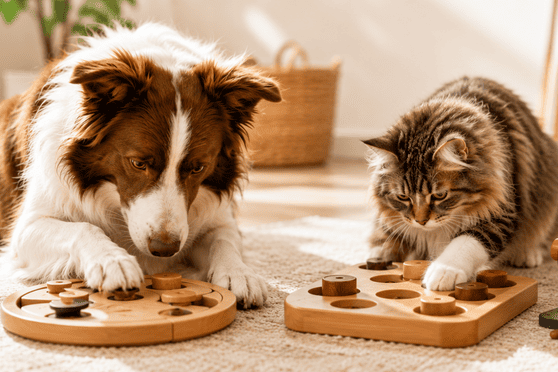
Hide-and-seek puzzles inspired by Sudoku
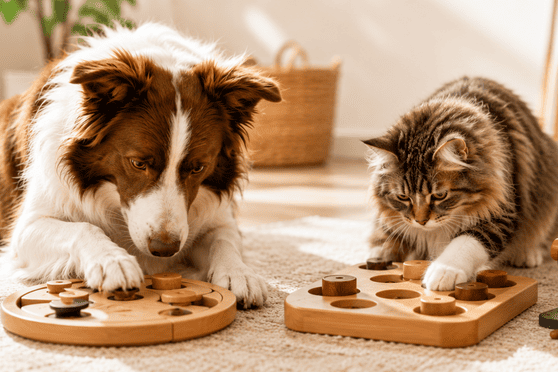
Inspired by the famous logic game, these wooden puzzles require your pet to slide movable pieces in order to reveal treats hidden inside several compartments. This is one of the most comprehensive formats for developing their sense of smell and patience: your pet must understand that a specific action, such as pushing or sliding, releases the reward. At Merlin & Cie, our Sudoku intelligence game for medium-sized dogs is perfect for a curious dog that likes to take their time, while the version designed for small dogs and cats is adapted to smaller, more delicate jaws and paws. Top tip: begin with only a few closed compartments so that your pet does not become discouraged during their first attempts.
Treat dispensers
These are often the ideal introduction to the world of intelligence games. The principle is simple and highly motivating: each movement of the toy, whether rolling, pushing or tipping it, releases a treat or some dry food. Perfect for food-loving pets or for slowing down an animal that eats too quickly, a treat dispenser and intelligence game for dogs and cats turns an ordinary meal into a genuine activity rather than something swallowed in thirty seconds.
Interactive toys with mechanisms
Some toys go even further by combining several actions, sometimes with sound or musical stimulation. This is the case with our interactive piano for dogs and cats, voted Product of the Year 2022. Your pet presses the keys to release a reward while having fun with the sound produced. It is an excellent way to develop precision, whether your pet uses a paw or their nose.
Wooden toys with different difficulty levels
For more experienced pets, or owners who appreciate attractive objects in their home, solid wooden toys often offer several progressive difficulty levels. This is a real advantage, allowing your pet to continue learning without becoming bored.
How to choose the right intelligence game
Three criteria are generally enough to help you make the right choice:
- Your pet’s size and strength. A puppy or cat will need a compact, lightweight design, while a large dog will appreciate a sturdier toy.
- Their level of experience. Always begin with an easy level, even if your pet progresses quickly. The aim is to create a sense of achievement, not frustration.
- The material. Solid wood, food-grade polypropylene or washable fabric: consider how easy the toy is to clean and how resistant it needs to be depending on your pet’s chewing habits.
Above all, provide variety! Alternating between two or three different games prevents boredom, just as we enjoy varying our own activities.
Our advice for a successful first experience
- Choose highly motivating treats, preferably small and strongly scented, for the first few sessions.
- Stay nearby at first to guide and encourage your pet without completing the game for them.
- Limit sessions to 10–15 minutes, several times a week, rather than one long and exhausting session.
- Put the toy away between uses: bringing it out again later will help renew your pet’s interest.
In summary
Giving your dog or cat an intelligence game is not simply offering them another gadget. It meets a fundamental need: the need to think, search and succeed. This need is just as essential as food or physical exercise and can make all the difference between an animal that simply endures each day and one that truly enjoys it.
At Merlin & Cie, we have carefully selected intelligence games for every type of pet, from curious puppies and indoor cats to senior dogs looking for gentle mental stimulation. Because your companion deserves more than just a toy: they deserve a genuine moment of bonding with you.







Leave a comment